Pinch Valves Manufacturer from India
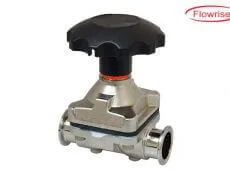
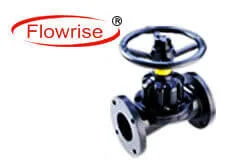
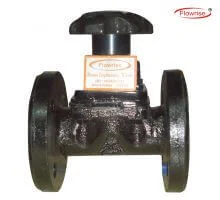
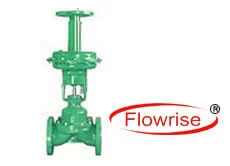
"Flowrise" "A" Pattern Diaphragm Valves are Mfg. As per the International Standards of BS, ASA, DIN ND-10/16 in a different combination of Body & Seat Material to control the Line Fluids with Zero Leakage. A Uniform weir Profile ensures the Steady Flow of Line Fluids.
Our Valves are Mfg. With various Body Elastomer Lining like Ebonite, Neoprene, Butyle, Hypalon, P. P. H.D.P.E. & P T F E with suitable lining thickness (t) for different sizes of valves. These valves can be effectively used to handle Pharmaceuticals, Foods, Dairy Products, as well as Beverages & water Treatment Plants.
| TYPE : | "A" Weir Pattern, Straight Type (KB) |
| MOC : | C.I. / C.S./ SS 304 / 304L / 316/ 316 L / Polypropylene |
| PRESSURE RATING ASA : | 150# |
| END CONNECTION : | Screwed End / Flanged End Diaphragm Valves |
| SIZE : | 1/2" to 12" |
| WIDELY USED FOR : | Diaphragm Valves for Pharmaceutical Industry, Food, Dairy, Chemical Industries and Many More. |
| NAME OF PARTS | QTY. | MATERIAL |
| SPINDLE | 1 | CARBON STEEL |
| HAND WHEEL | 1 | CI IS 210 GR.20 |
| GRIP LOCK SCREW | 3 | CARBON STEEL |
| BONNET | 1 | CI IS 210 GR.20 |
| BUSHING | 1 | GM ASTM B 62 |
| THRUST COLLER | 1 | GM ASTM B62 |
| COMPRESSOR PIN | 1 | CARBON STEEL |
| COMPRESSOR | 1 | CI IS 210 GR. 20 |
| DIAPHRAGM STUD | 1 | BRASS |
| BONNET BOLTS | 4 | CS A 307-GB |
| BONNET NUTS | 4 | CS A 307-GB |
| DIAPHRAGM | 1 | - |
| BODY | 1 | CI IS 210 GR 20 |
| LINING | - | - |
| GREASE | 1 | BRASS |
| Size | M.M. | 15 | 20 | 25 | 32 | 40 | 50 | 65 | 80 | 100 | 125 | 150 | 200 | 250 | 300 | 350 |
| A | M.M | 102 | 117 | 127 | 146 | 159 | 190 | 216 | 254 | 305 | 356 | 406 | 520 | 635 | 750 | 750 |
| B | M.M | 76 | 90 | 108 | 120 | 142 | 171 | 200 | 241 | 273 | 324 | 368 | 514 | 610 | 710 | 914 |
| C | M.M | 70 | 70 | 100 | 100 | 114 | 150 | 150 | 200 | 250 | 300 | 350 | 482 | 610 | 710 | 710 |
| D | M.M | 9.5 | 15 | 17 | 19 | 21 | 28 | 32 | 45 | 60 | 65 | 80 | - | - | - | - |
| Thickness of Rubber Lining | M.M | 3.0 | 3.0. | 3.0 | 3.0 | 3.0 | 3.0 | 3.0 | 4.0 | 4.0 | 5.0 | 5.0 | 6.0 | 6.0 | 6.0 | 6.0 |
A diaphragm valve is a linear motion valve used to start, stop, or regulate fluid flow. It consists of a flexible diaphragm (made of rubber, elastomer, or PTFE) attached to a stem and compressor.

Request A Quote

